

Hydroxypropyl alpha cyclodextrin (HPαCD) is a modified cyclic oligosaccharide that has gained significant attention in various industries, especially in pharmaceuticals, cosmetics, and food. Its unique ability to form inclusion complexes with a wide range of guest molecules makes it a valuable ingredient. In this blog, we will delve into how HPαCD works in inclusion complex formation, and as a supplier of HPαCD, we will also touch on the practical applications and benefits of these complexes.

Structure and Properties of Hydroxypropyl Alpha Cyclodextrin
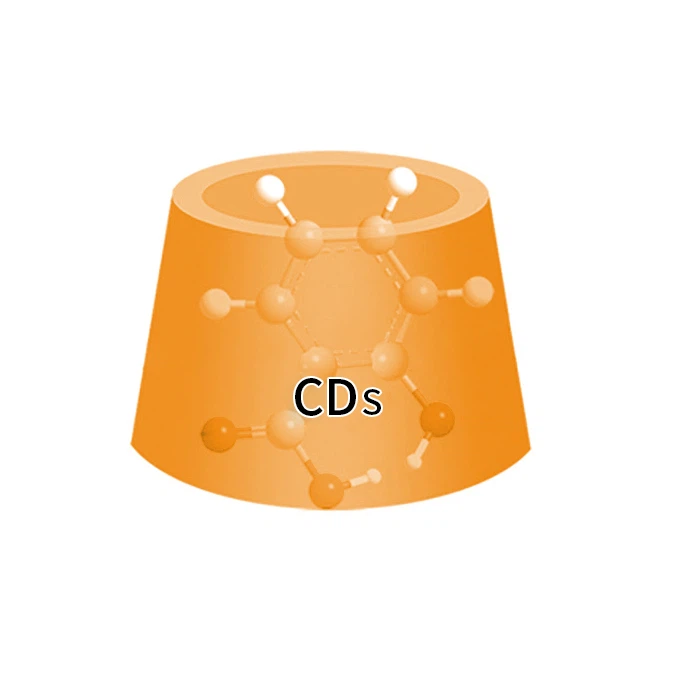
HPαCD is derived from alpha - cyclodextrin, which consists of six glucose units linked by α - 1,4 - glycosidic bonds, forming a toroidal or cone - shaped structure. The primary hydroxyl groups are located at the narrow end of the torus, while the secondary hydroxyl groups are at the wider end. The introduction of hydroxypropyl groups onto the cyclodextrin molecule enhances its water solubility compared to the native alpha - cyclodextrin.
The interior of the HPαCD cavity is relatively hydrophobic, while the exterior is hydrophilic. This amphiphilic nature is the key to its ability to form inclusion complexes. The hydrophobic cavity can accommodate hydrophobic guest molecules, while the hydrophilic exterior allows the complex to dissolve in aqueous solutions.
Mechanism of Inclusion Complex Formation
The formation of inclusion complexes between HPαCD and guest molecules is a dynamic process based on non - covalent interactions. These interactions include van der Waals forces, hydrogen bonding, hydrophobic interactions, and electrostatic interactions.
Hydrophobic Interactions
Hydrophobic interactions play a dominant role in the inclusion complex formation. Hydrophobic guest molecules tend to be excluded from the aqueous environment. When they encounter the hydrophobic cavity of HPαCD, they can enter the cavity to minimize their contact with water. This process is thermodynamically favorable as it reduces the surface area of the hydrophobic molecule exposed to water, leading to an increase in the entropy of the system.
For example, resveratrol is a hydrophobic polyphenol with limited water solubility. When HPαCD is present in the solution, resveratrol molecules can enter the HPαCD cavity through hydrophobic interactions. This results in the formation of a 10% Water - soluble Resveratrol inclusion complex, which has improved water solubility and stability.
Van der Waals Forces
Van der Waals forces are weak intermolecular forces that arise from the temporary dipoles induced in molecules. In the inclusion complex, the guest molecule and the inner surface of the HPαCD cavity are in close proximity. The van der Waals forces between the atoms of the guest molecule and the cyclodextrin cavity help to stabilize the complex. These forces are particularly important when the size and shape of the guest molecule fit well within the cavity of HPαCD.
Hydrogen Bonding
Although the interior of the HPαCD cavity is hydrophobic, the hydroxyl groups on the exterior of the cyclodextrin can form hydrogen bonds with the guest molecule or with water molecules in the solution. Hydrogen bonding can contribute to the overall stability of the inclusion complex. For instance, if the guest molecule has functional groups such as hydroxyl, carbonyl, or amino groups, it can form hydrogen bonds with the hydroxyl groups of HPαCD.
Electrostatic Interactions
In some cases, electrostatic interactions can also play a role in inclusion complex formation. If the guest molecule has charged groups and the cyclodextrin has a suitable charge distribution, electrostatic attractions or repulsions can influence the complexation process. However, this is less common compared to hydrophobic and van der Waals interactions.
Factors Affecting Inclusion Complex Formation
Several factors can affect the formation and stability of inclusion complexes between HPαCD and guest molecules.
Size and Shape Complementarity
The size and shape of the guest molecule must be compatible with the cavity of HPαCD. If the guest molecule is too large, it may not fit into the cavity, and if it is too small, the interactions between the guest and the cavity may be weak. For example, lipoic acid is a small molecule that can form a stable inclusion complex with HPαCD, resulting in a 12% Lipoic Acid Inclusion Complex. The size and shape of lipoic acid allow it to fit well within the HPαCD cavity, leading to strong non - covalent interactions.
Temperature
Temperature can influence the inclusion complex formation. Generally, an increase in temperature can increase the kinetic energy of the molecules, which may enhance the rate of complex formation. However, at very high temperatures, the non - covalent interactions holding the complex together may be disrupted, leading to the dissociation of the complex.
pH
The pH of the solution can affect the ionization state of the guest molecule and the cyclodextrin. If the guest molecule is a weak acid or base, its solubility and the ability to form inclusion complexes can be pH - dependent. For example, salicylic acid is a weak acid. At different pH values, its ionization state changes, which can affect its interaction with HPαCD. A 10% Water - soluble Salicylic Acid Inclusion Complex can be formed under appropriate pH conditions.
Applications of HPαCD Inclusion Complexes
The ability of HPαCD to form inclusion complexes has led to its wide use in different industries.
Pharmaceuticals
In the pharmaceutical industry, HPαCD is used to improve the solubility, stability, and bioavailability of poorly soluble drugs. By forming inclusion complexes with drugs, HPαCD can increase the drug's dissolution rate in the gastrointestinal tract, leading to better absorption. It can also protect the drug from degradation by environmental factors such as light, oxygen, and moisture.
Cosmetics
In cosmetics, HPαCD inclusion complexes are used to enhance the solubility and stability of active ingredients. For example, the water - soluble resveratrol and lipoic acid inclusion complexes mentioned above can be easily incorporated into cosmetic formulations. These complexes can improve the delivery of active ingredients to the skin, enhancing the efficacy of the cosmetic products.
Food
In the food industry, HPαCD can be used to encapsulate flavors, vitamins, and other bioactive compounds. The inclusion complexes can improve the stability of these compounds during processing, storage, and transportation. They can also mask unpleasant tastes and odors of certain food ingredients.
Conclusion
Hydroxypropyl alpha cyclodextrin is a versatile molecule with a remarkable ability to form inclusion complexes with a wide range of guest molecules. The formation of these complexes is based on non - covalent interactions, primarily hydrophobic interactions. Factors such as size and shape complementarity, temperature, and pH can affect the complexation process.
As a supplier of HPαCD, we understand the importance of this molecule in various industries. Our high - quality HPαCD can help you create innovative products with improved solubility, stability, and bioavailability of active ingredients. If you are interested in purchasing HPαCD or learning more about its applications in inclusion complex formation, please feel free to contact us for further discussion and negotiation.
References
- Loftsson, T., & Duchêne, D. (2007). Cyclodextrins and their pharmaceutical applications. International Journal of Pharmaceutics, 329(1 - 2), 1 - 11.
- Szejtli, J. (1998). Introduction and general overview of cyclodextrin chemistry. Chemical Reviews, 98(5), 1743 - 1753.
- Stella, V. J., & He, Q. (2008). Cyclodextrins as pharmaceutical solubilizers. Pharmaceutical Research, 25(4), 1017 - 1025.


