

Hey there! As a supplier of Hyperbranched Cyclodextrin, I've been diving deep into the world of these amazing molecules. One question that keeps coming up is how the degree of substitution affects the properties of hyperbranched cyclodextrin. So, let's dig in and explore this topic together.
First off, what exactly is hyperbranched cyclodextrin? Well, cyclodextrins are cyclic oligosaccharides made up of glucose units. They have a unique structure with a hydrophobic cavity on the inside and a hydrophilic exterior. Hyperbranched cyclodextrins take this basic structure and add a highly branched architecture, which gives them some really interesting properties. You can learn more about Hyperbranched Cyclodextrin on our website.
The degree of substitution (DS) refers to the number of hydroxyl groups on the cyclodextrin molecule that have been replaced with other functional groups. This can have a huge impact on the properties of the hyperbranched cyclodextrin. For example, a higher DS can increase the solubility of the cyclodextrin in water. This is because the new functional groups can interact with water molecules more effectively, making it easier for the cyclodextrin to dissolve.
On the other hand, a lower DS might result in a more hydrophobic cyclodextrin. This can be useful in applications where you need the cyclodextrin to interact with non - polar substances. For instance, in the encapsulation of hydrophobic drugs, a cyclodextrin with a lower DS can form inclusion complexes more readily with the drug molecules.
Let's talk about some of the specific properties that are affected by the degree of substitution.

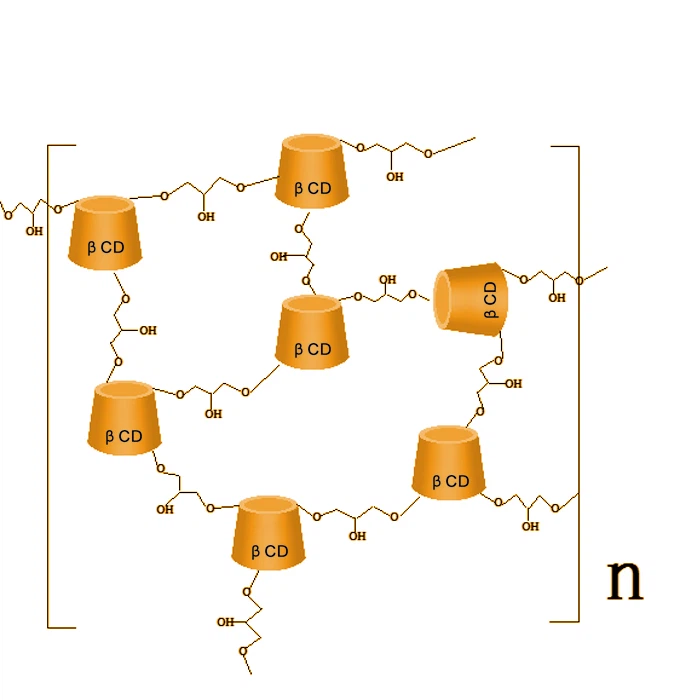
Solubility
As I mentioned earlier, solubility is one of the most significant properties influenced by the DS. When we increase the degree of substitution, we're essentially changing the chemical nature of the cyclodextrin surface. If we substitute the hydroxyl groups with hydrophilic groups like carboxymethyl or hydroxypropyl, the cyclodextrin becomes more water - soluble. This is great for applications in the pharmaceutical industry, where drugs often need to be in a soluble form for effective delivery. For example, Piroxicam Beta Cyclodextrin is a compound where the cyclodextrin's solubility plays a crucial role in enhancing the bioavailability of piroxicam.
Complexation Ability
The ability of hyperbranched cyclodextrin to form inclusion complexes with other molecules is also affected by the DS. Inclusion complexes are formed when a guest molecule fits into the hydrophobic cavity of the cyclodextrin. A higher DS can change the size and shape of the cavity, as well as the chemical environment inside it. This can either enhance or reduce the complexation ability, depending on the nature of the guest molecule. If the guest molecule is hydrophobic, a cyclodextrin with a lower DS might form a more stable complex because the cavity remains more hydrophobic.
Stability
The stability of hyperbranched cyclodextrin can be influenced by the degree of substitution. When we introduce new functional groups through substitution, we can change the intermolecular forces between the cyclodextrin molecules. A higher DS can lead to stronger intermolecular interactions, which can increase the physical stability of the cyclodextrin. This is important in applications where the cyclodextrin needs to maintain its structure under different conditions, such as in food products or cosmetics.
Viscosity
Viscosity is another property that can be affected by the DS. As the degree of substitution increases, the cyclodextrin molecules can interact with each other more strongly, leading to an increase in viscosity. This can be both an advantage and a disadvantage, depending on the application. In some cases, a higher viscosity can be useful for creating gels or thickening agents. However, in other applications where a low - viscosity solution is required, a lower DS might be more appropriate.
Surface Activity
The surface activity of hyperbranched cyclodextrin is also related to the degree of substitution. A higher DS can make the cyclodextrin more surface - active, which means it can reduce the surface tension of a liquid. This can be useful in applications such as emulsification, where we need to mix two immiscible liquids. For example, in the production of Chlorpropanol Cyclodextrin, the surface activity of the cyclodextrin can play a role in the formation of stable emulsions.
Applications Based on DS
The degree of substitution determines which applications the hyperbranched cyclodextrin is best suited for.
Pharmaceutical Applications
In the pharmaceutical industry, different DS values are used for different purposes. For drugs that are poorly soluble in water, a cyclodextrin with a high DS and good water - solubility can be used to improve the drug's bioavailability. On the other hand, for drugs that are highly lipophilic, a cyclodextrin with a lower DS can be more effective in encapsulation.
Food and Beverage Industry
In the food and beverage industry, the solubility and stability properties of hyperbranched cyclodextrin are crucial. A cyclodextrin with a high DS can be used to solubilize flavors and colors, while a lower DS cyclodextrin might be used to encapsulate and protect sensitive ingredients from oxidation or degradation.
Cosmetics
In cosmetics, the surface activity and solubility of cyclodextrin are important. A high - DS cyclodextrin can be used to create stable emulsions in creams and lotions, while a cyclodextrin with a lower DS can be used to encapsulate fragrances and other active ingredients.
Controlling the Degree of Substitution
As a supplier, we have the ability to control the degree of substitution during the synthesis process. We use advanced chemical techniques to ensure that we can produce hyperbranched cyclodextrins with the desired DS for different applications. This allows us to provide our customers with cyclodextrins that are tailored to their specific needs.
Conclusion
In conclusion, the degree of substitution has a profound impact on the properties of hyperbranched cyclodextrin. From solubility and complexation ability to stability and surface activity, every aspect of the cyclodextrin's behavior can be fine - tuned by adjusting the DS. Whether you're in the pharmaceutical, food, or cosmetic industry, understanding how the DS affects the properties of hyperbranched cyclodextrin is essential for choosing the right product for your application.
If you're interested in learning more about our hyperbranched cyclodextrins or have specific requirements regarding the degree of substitution, we'd love to hear from you. Contact us to start a discussion about your needs and how our products can meet them. We're here to help you find the perfect cyclodextrin solution for your business.
References
- Szejtli, J. (1988). Cyclodextrin inclusion compounds in research and industry. Chemical Reviews, 88(4), 373 - 399.
- Loftsson, T., & Brewster, M. E. (1996). Pharmaceutical applications of cyclodextrins. 1. Drug solubilization and stabilization. Journal of Pharmaceutical Sciences, 85(10), 1017 - 1025.
- Davis, M. E., & Brewster, M. E. (2004). Cyclodextrin - based pharmaceutics: past, present and future. Nature Reviews Drug Discovery, 3(12), 1023 - 1035.


