


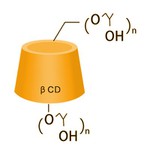

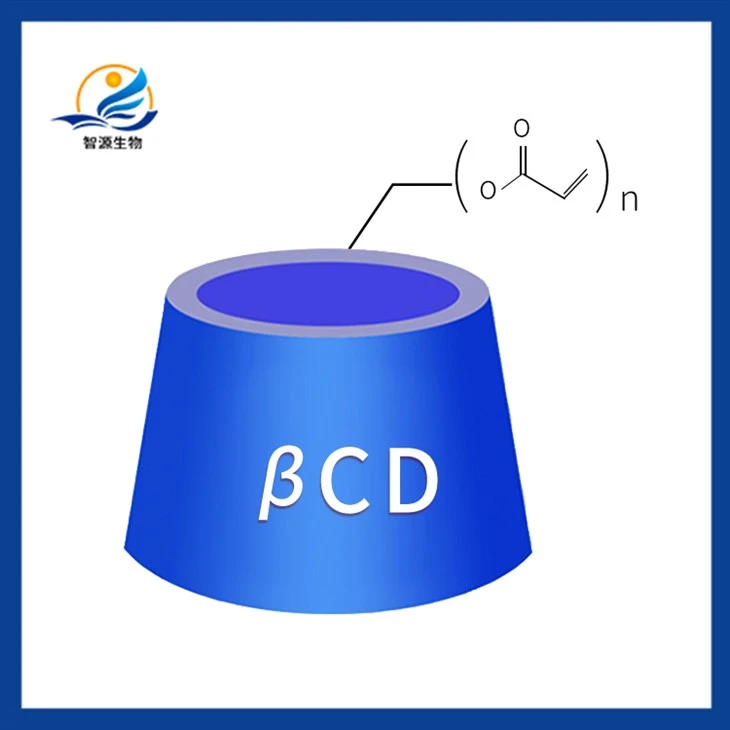
Acrylic Beta-Cyclodextrin (β-CD-AA)
Quick Details
|
Name |
Acrylic Beta-Cyclodextrin (β-CD-AA) |
|
CAS No. |
---- |
|
Molecular Formula |
C42H70-nO35·(C3H3O)n |
|
Molecular Weight |
1135.0 + 54.1n |
|
Appearance |
white powder, insipid, innocent |
|
Assay |
≥90% |
|
Classification |
Oral Grade |
|
quality standard |
CP/USP/EP Standard |
|
DMF No. |
030168 |
Product quality advantage
|
Test Item |
Specification |
Test Method |
|
Character |
Off-white to pale yellow powder or granules; no visible impurities |
Visual inspection + microscopic observation (100× magnification) |
|
Identification |
Infrared absorption spectrum matches the reference spectrum (main characteristic peaks: 3400-3200 cm⁻¹ for -OH, 1720-1700 cm⁻¹ for C=O, 1630-1620 cm⁻¹ for C=C) |
FT-IR Spectroscopy (KBr pellet method) |
|
Solution Clarity |
Clear solution; no turbidity or visible particles after standing for 24 hours (10% w/v aqueous solution) |
Visual inspection against a black background |
|
pH Value |
6.0 ~ 8.0 |
Digital pH meter (1% w/v aqueous solution, 25℃) |
|
Acrylic Acid Content |
≤ 1% (w/w) |
High Performance Liquid Chromatography (HPLC): C18 column, mobile phase: methanol/water = 40/60 (v/v), detection wavelength: 205 nm |
|
β-CD Content |
≤ 10% (w/w) |
HPLC: Aminopropylsilane column, mobile phase: acetonitrile/water = 70/30 (v/v), detection wavelength: 195 nm |
|
Degree of Substitution (DS) |
1.0 ~ 4.0 |
Proton Nuclear Magnetic Resonance (¹H-NMR): DMSO-d₆ as solvent, internal standard: tetramethylsilane (TMS) |
|
Loss on Drying |
≤ 10% (w/w) |
Vacuum drying at 60℃ for 4 hours until constant weight |
|
Heavy Metals |
≤ 10 ppm (total of Pb, Cd, Hg, As) |
Inductively Coupled Plasma Mass Spectrometry (ICP-MS) |
|
Microbial Limit |
Total aerobic microbial count ≤ 100 CFU/g; Yeast and mold ≤ 10 CFU/g; No pathogenic bacteria detected |
ISO 11737-1 standard method |
Product Introduction
Acrylic Beta-Cyclodextrin (β-CD-AA) is a modified cyclodextrin derivative with synergistic performance, combining the advantages of natural β-CD and acrylic functional groups:
✅ Superior Inclusion Capacity: Maintains the hydrophobic cavity structure of β-CD (cavity diameter: ~0.65 nm), enabling stable inclusion complexes with small-molecule active ingredients (molecular weight 100-400 Da), such as drugs, fragrances, and antioxidants, with inclusion efficiency up to 85-95%
✅ Enhanced Water Solubility: Compared with native β-CD (solubility: ~1.8 g/100 mL), the introduction of acrylic groups improves water solubility by more than 10 times, suitable for water-based formulations and biological systems
✅ Controllable Chemical Tunability: The degree of substitution (1.0-4.0) can be customized according to application requirements; the reactive double bonds (-C=C-) allow copolymerization with monomers such as acrylamide, N-isopropylacrylamide, and acrylic acid, enabling the design of polymers with tailored properties (e.g., responsiveness, mechanical strength)
✅ Excellent Biocompatibility: In vitro cytotoxicity test (MTT assay) shows cell viability ≥ 90% at a concentration of 5 mg/mL (L929 cells), meeting the biocompatibility requirements for biomedical and cosmetic applications
✅ Stable Performance: Resistant to hydrolysis under neutral and weakly acidic/basic conditions (pH 5.0-9.0); thermal stability up to 120℃ (decomposition temperature > 200℃), ensuring compatibility with common processing technologies (e.g., mixing, coating, polymerization)
Manufacturer information


Features
Acrylic Beta-Cyclodextrin (β-CD-AA) is a high-performance modified cyclodextrin derivative, integrating the unique inclusion capacity of natural β-CD with polymerizable acrylic functional groups.
Application
1. Drug Delivery & Controlled Release
Core Application: Construct pH-sensitive hydrogel drug carriers for oral, topical, or injectable formulations
Technical Principle: The acrylic double bonds polymerize to form crosslinked hydrogels; the β-CD cavity loads poorly soluble drugs (e.g., paclitaxel, curcumin), and the hydrogel swells/degrades in response to intestinal pH (pH 6.8-7.4), achieving targeted release
Practical Value: Improves the solubility of poorly soluble drugs by 5-20 times; extends drug release time to 12-24 hours (sustained release); reduces side effects by avoiding drug release in the stomach (pH 1.0-3.0); validated in preclinical studies for anti-tumor, anti-inflammatory, and antibacterial drug delivery
Typical Formulations: Oral sustained-release tablets, transdermal drug patches, injectable microgels
2. Smart Materials & Biomedical Engineering
Smart Antibacterial Coatings: Copolymerizes with antibacterial monomers (e.g., quaternary ammonium salts) to form pH/temperature-responsive coatings for medical devices (catheters, implants); the coating releases antibacterial agents on demand when exposed to bacterial biofilm (pH ~5.5-6.0), achieving long-term antibacterial effects (≥ 7 days) with antibacterial rate > 99% against E. coli and S. aureus
Tissue Engineering Scaffolds: Crosslinks with gelatin/hyaluronic acid to prepare porous scaffolds (pore size: 100-300 μm) for skin, bone, or cartilage repair; the β-CD cavity loads growth factors (e.g., VEGF, BMP-2) for controlled release, promoting cell proliferation and tissue regeneration; the scaffold has a compressive modulus of 5-20 kPa, matching the mechanical properties of soft tissues
Wound Dressings: Integrates with hydrocolloids to form moisture-retentive dressings; loads antibacterial drugs and growth factors, accelerating wound healing by 30-50% compared to conventional dressings
3. Adsorption & Separation Materials
Heavy Metal Ion Removal: Polymerizes to form porous adsorbent beads (particle size: 1-3 mm) with β-CD cavities as adsorption sites; specifically adsorbs Pb²⁺ (adsorption capacity: 80-120 mg/g), Zn²⁺ (60-90 mg/g), Cu²⁺ (50-80 mg/g), and Cd²⁺ (40-70 mg/g) from industrial wastewater
Technical Advantages: High selectivity (adsorption selectivity coefficient Pb²⁺/Ca²⁺ > 50); fast adsorption rate (equilibrium time: 30-60 minutes); good regeneration performance (can be reused ≥ 5 times with acid washing, adsorption capacity retention ≥ 85%); compliant with environmental discharge standards (treated water heavy metal content ≤ 0.05 ppm)
Application Scenarios: Electroplating wastewater treatment, mining wastewater purification, drinking water purification
4. Functional Additives (Cosmetics & Food Industry)
Cosmetics: Used as a stabilizer and solubilizer in skincare, haircare, and sunscreen products;
Stabilizes sensitive ingredients: Protects vitamins (C, E), retinol, and fragrances from oxidation and photodegradation, extending product shelf life by 1-2 years;
Improves solubility: Solubilizes oil-soluble active ingredients (e.g., coenzyme Q10, squalane) in water-based formulations, avoiding phase separation;
Enhances efficacy: Promotes the penetration of active ingredients into the skin stratum corneum, improving moisturizing, anti-aging, and whitening effects
Food Industry: Functions as a food additive (E-number pending approval) for:
Stabilizing food pigments (e.g., β-carotene, anthocyanins) and flavors, preventing degradation during processing and storage;
Reducing bitterness/off-flavors (e.g., in soy products, functional foods) by encapsulating bitter compounds;
Improving the stability of probiotics in functional foods, enhancing their survival rate in the gastrointestinal tract (survival rate ≥ 80% vs. ≤ 50% without encapsulation)
Packing & Storage
● Packing: 1kg/2kg/10kg/20kg/drum or carton
● Storage: Preserve well-closed containers protect from moisture.
● Inner packaging: sterile PE bag, aluminum foil bag;
● Outer packaging: full carton;


FAQ
Q: Does your company is a factory or trade company?
Q: What's the main advantages about your Oral Grade Hydroxypropyl Beta Cyclodextrin?
Q: What's the quality assurance you provided?
Q: How do you control quality?
Q: Can purchaser come to audit?
Hot Tags: acrylic beta-cyclodextrin (β-cd-aa), China acrylic beta-cyclodextrin (β-cd-aa) manufacturers, suppliers, leisure product, souvenir product, gift product, attractive product, newly launched product, special interest product
Previous
Succinyl ChitosanYou Might Also Like


Send Inquiry